by Vinay Parameswara
When most people hear the word resilience, they think of strength. They likely picture someone who never breaks, never cries, never doubts, and somehow keeps moving forward despite overwhelming adversity.
That is true sometimes.
But to me, resilience is something far deeper than toughness. It isn’t simply psychological endurance or the ability to bounce back. At least to me, it is the willingness to let suffering change us without letting it define who we are. Even when life strips away the identity which we thought was permanent, something deeper within us can continue to unfold.
We have to make a strong effort and will it.
Dr. Rudolf Steiner says that the human being is not a finished creation but a being continually becoming. We are not simply biological organisms adapting to our environment. We are spiritual beings whose biographies unfold through encounters with resistance and with our will and action. Every challenge, every accident, every disappointment, every illness, every failure presents the possibility—not the certainty, but the possibility—of awakening capacities that otherwise would have remained slumbering. We get plenty of opportunities to awaken and strengthen those capacities throughout our lives. This understanding radically changes the question we ask in times of suffering. Instead of “How can I return to who I was?” we begin asking, “Who is this experience inviting me to become?” The poet Novalis said, “returning to health does not mean going backward or trying to reset to the exact musical note you were playing before….”
This shift in thinking transformed my life.
As a physician, I spent years caring for patients whose lives had been divided into “before” and “after” by severe medical diagnoses like ALS or end-stage kidney disease or liver failure or multiple sclerosis or stroke or cancer. I watched fear enter the room the moment someone heard the words, “You have cancer.” Many described feeling as though the ground beneath them had disappeared.
The future they had carefully imagined suddenly dissolved, and questions emerged that conventional medicine alone could never answer.
Why me?
Will I ever feel normal again?
What is the purpose of my life now?
Several years ago, my own biography came to an unexpected halt after I made a serious professional mistake. I accepted responsibility for my actions, pleaded guilty, and eventually served time in federal prison. Almost overnight, everything that had defined my identity seemed to disappear—my career, my reputation, my future as I had imagined it. Time stopped.
This affected not just me, but my family, coworkers, friends, community, peers, and my patients. However, through all this, it was such a blessing to be supported by those who knew me and the whole story. I received an overwhelming amount of love, kindness, hope, warmth, trust, and generosity. Most importantly, I was deeply moved by the letters of support and prayers from my community, patients, as well as my colleagues.

Steiner says that karma plays a role in illnesses, mishaps, accidents, and life in general. Whether it is a cancer diagnosis or imprisonment, our karma gives us opportunities. We have freedom to act within those destinies. We have freedom to make moral decisions and create new karma. I am not saying a prison sentence is the same as a medical diagnosis, but, for the first time, I found myself grappling with the same kind of questions. Like many people facing a devastating diagnosis, I entered an unfamiliar world filled with uncertainty. I struggled with severe anxiety, insomnia, headaches, loss of appetite, weight loss, and constant fear accompanied by tears. Separation from my family, the violence of prison life, overcrowding, noise, loss of privacy, and the continual awareness of danger became daily realities. Who am I now? Is there life beyond this?
Why are others suffering because of me?
I immersed myself in Anthroposophy. I received books from family, friends, and the Anthroposophical Prison Outreach. I studied Steiner daily at every opportunity from lights-on to lights-out and contemplated his words. Anthroposophy offers a remarkable understanding of the spiritual forces that challenge resilience. When suffering enters our lives, I believe Lucifer tempts us toward fantasy, self-pity, and escape. He whispers that we are victims, that reality should be different.
His gift of vanity offers a veil. And from the other side, Ahriman offers the opposite temptation. He insists that only material facts exist. We become nothing more than our diagnosis, our prison sentence, our laboratory values, our mistakes, or our failures and get caught up in ourselves. Both deny the true nature of the human being.
While Lucifer draws us away from reality, Ahriman imprisons us within the materialistic realm. (For those unfamiliar with the terms Lucifer and Ahriman, they are ancient names used by Rudolf Steiner to describe beings that represent the polarities of evil and the double nature of the human being).
The Christ impulse stands between these extremes—not denying suffering, yet refusing to let suffering become our identity. He walks the middle path. Christ transforms suffering into love through freedom.
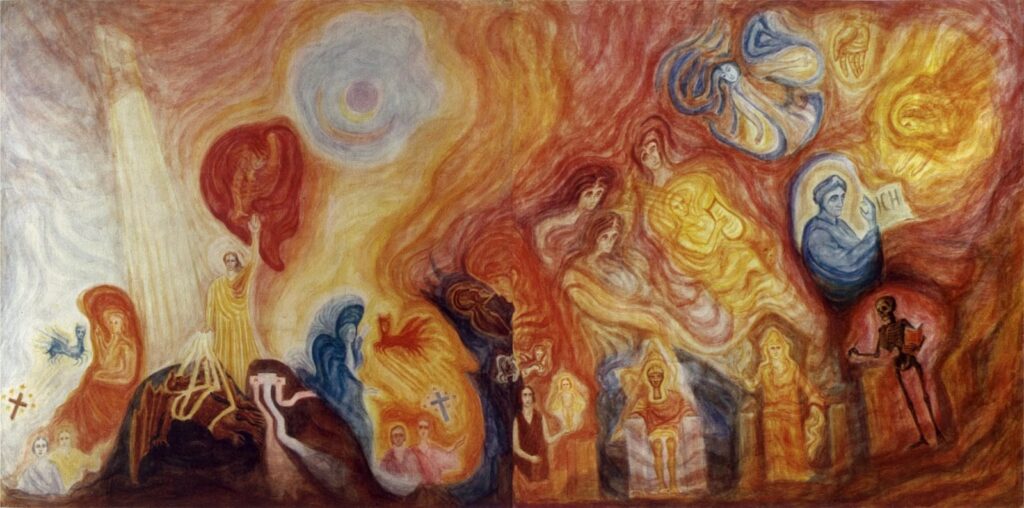
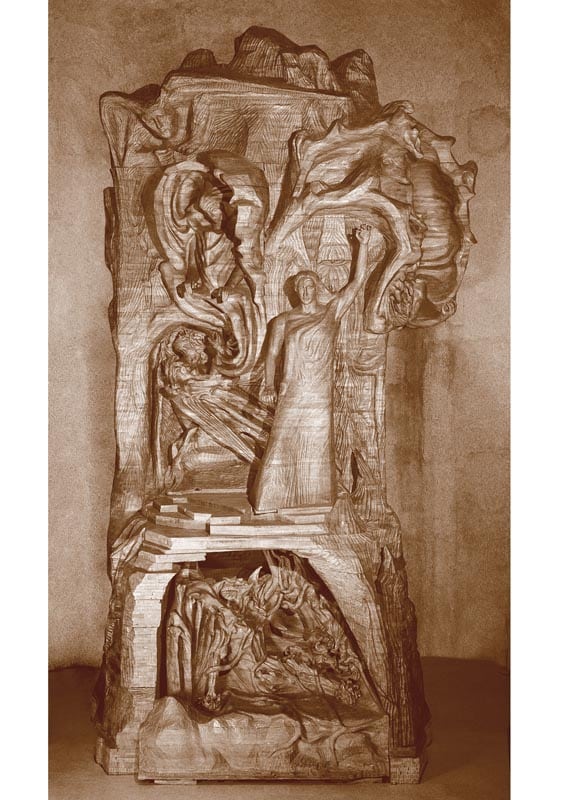
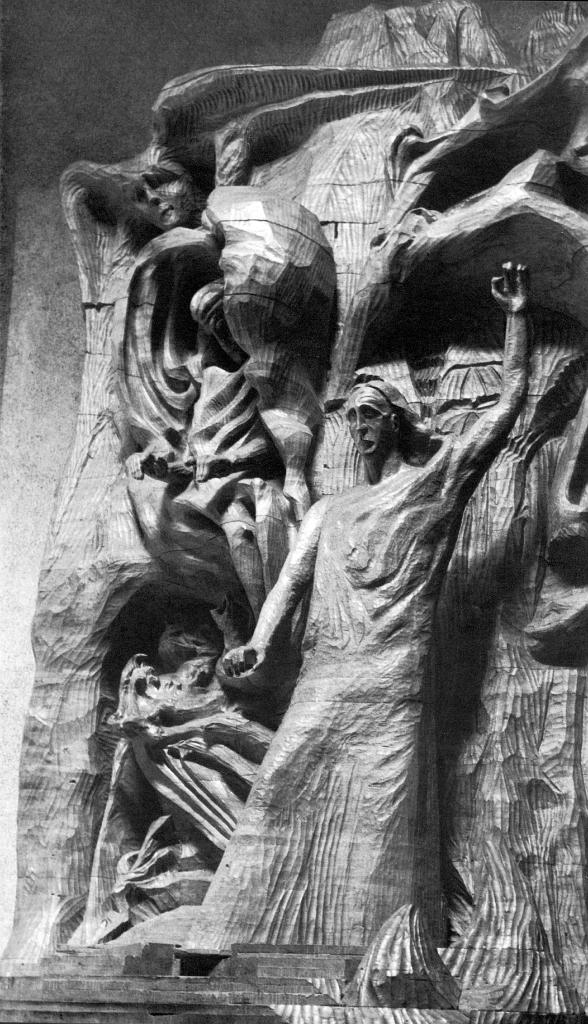
I believe that this middle path has a lot to do with resilience. The image of Steiner’s Representative of the Human Being changed many things inside me.
For instance, it directed my attention to the positives in my situation and reinforced the fourth exercise—to seek Truth, Beauty, and Goodness in every situation (from Rudolf Steiner’s six basic exercises, as described by Brian Gray in the following video)
Steiner says pralaya refers to a period of dissolution, a flood, a time between epochs when an old world passes away before a new creation can emerge. And every human biography encounters numerous periods of pralaya—different types, all of them unique to each of us.
Illness. Loss. Failure. Bereavement. Imprisonment. Accidents. The collapse of certainty.
When, during such times, it appears that everything has ended, Anthroposophy invites us to see something different. The pralaya is not the destination. It is the sea through which the human spirit must navigate. Resilience is the vessel that carries us across those dark waters—not back to the shore we left behind. Rather, it brings us, if we navigate consciously, to the harbor of becoming more human.
I owe it to Anthroposophy, which gave me courage and strength to stay the course.
Looking back, I would never choose the painful chapters of my biography. Yet I cannot deny what they have taught me. They stripped away illusion. They exposed weaknesses I had never recognized. They deepened my understanding of suffering, forgiveness, and compassion. I became freer inside than I was before I entered the prison walls. Most importantly, they rekindled my desire to serve others with greater humility, joy, and excitement than I possessed before.
I still don’t understand why we need the devil to become more human.
I once believed resilience meant surviving adversity. Now I believe resilience means allowing adversity to participate in our evolution. The physical body will one day perish. Our careers, accomplishments, and reputations will eventually fade. What endures are the capacities we have cultivated, the love we have learned to give, the freedom we have awakened, and the deeper humanity we have gradually grown into. The essence of this is what we take to our next incarnation.
Resilience is not about never breaking. It is about discovering that even broken places can become openings through which compassion, wisdom, and purpose enter our lives.
Perhaps that is the deepest meaning of resilience and where true healing begins.
I owe a great deal to Anthroposophy. It gave me the courage and strength to stay the course through my pralaya.
“A Verse for Our Time”
(acted as a crutch for my resilience while I was doing time….)
We must eradicate from the soul
All fear and terror of what comes towards man out of the future.
We must acquire serenity
In all feelings and sensations about the future.
We must look forward with absolute equanimity To everything that may come.
And we must know only that whatever comes
Is given to us by a world-directive full of wisdom.
It is part of what we must learn in this age, namely, to live out of pure trust,
Without any security in existence.
Trust in the ever present help Of the spiritual world.
Truly, nothing else will do
If our courage is not to fail us.
And let us seek the awakening from within ourselves Every morning and every evening.
With Love and Gratitude,
Vinay
P.S. I would love to hear from you if you have any thoughts on this matter or if you are interested in the details of my legal case, life in prison as well as in an ICE holding facility. Please email me at: [email protected]
Dr. Vinay Parameswara is an anthroposophic physician residing in Texas. He is a trusted colleague who recently went through a challenging legal situation. His enthusiasm and deep support for anthroposophy have demonstrated a deep resilience from which we can all benefit and learn. Thank you Vinay! Dr. Steven M Johnson
This post was originally published in the Fall 2026 Newsletter